The following feature stories were written for my Sports Media capstone course.
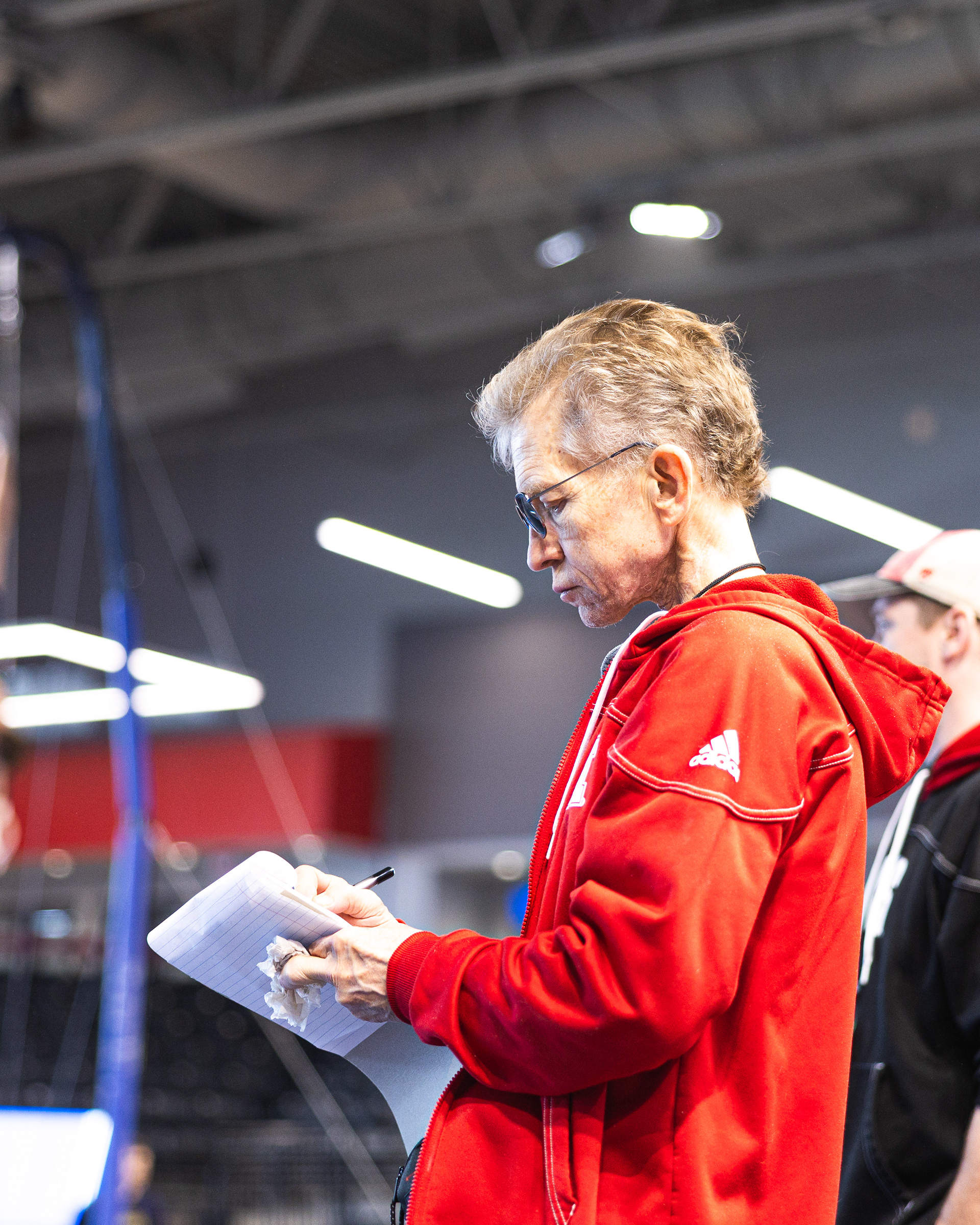
More than medals: Hartung reflects on Husker Gymnastics legacy
When Jim Hartung competed for Nebraska in the 1980s, there were nearly 80 men’s gymnastics programs across the country. Today, fewer than 15 remain. Hartung’s story — Olympian, champion, mentor — reflects both the glory and fragility of the sport in America.
Hartung got his start in gymnastics at 5 years old after following his sister into a local acrobatics program. Born and raised in Omaha, Hartung chose to attend the University of Nebraska in 1979 not just for its strong gymnastics program, but to keep family ties and for a community that had supported him from the start.
“While I considered a couple of other schools growing up, going to Nebraska was a no-brainer. My parents never missed a competition – for like 40-plus years straight,” Hartung said. “My best friend was on the team, and I was pretty impressed by [then head coach] Francis Allen.”
As a Husker, Hartung quickly became a force in men’s gymnastics, leading Nebraska to four consecutive national championships between 1979 and 1982. Hartung still holds the NCAA record for seven individual national titles, a Nebraska record of 22 All-America honors, and a program record of 76 combined individual titles throughout his career. Former teammate and now head coach for Nebraska, Chuck Chmelka, described Hartung’s legacy as simply “unmatched.”
“As an athlete, he won everything he possibly could win,” Chmelka said. “He's pretty much the GOAT.”
During Hartung’s era, Nebraska men’s gymnastics was a national powerhouse that drew attention across the country, garnering record crowds of over 27,000 fans while hosting three straight national championships at the Bob Devaney Sports Center.
“We had the top men’s gymnastics facility in the country,” Hartung said. “Our fans, like all Husker sports fans, were by far and away the best in the country. We set a new attendance record for the NCAA Gymnastics Championships three years in a row.”
The media attention, the caliber of gymnastics, and the Huskers’ championship streak placed them at the center of one of the sport’s most historic rivalries with the Oklahoma Sooners, where Hartung and Oklahoma’s Bart Conner went head-to-head, trading titles and recognition as the top gymnasts in the country.
“It was during the heyday of the Big Eight,” Conner said. “Our two coaches didn’t get along very well at the time, and the writers kind of threw fuel on the flames. We were all world-class, and the rivalry just made it that much more compelling.”
Still today, Hartung recalls the NCAA team final as the “most exciting men’s competition there is.”
“You are on a team with guys that you trained for hours with every day for years,” Hartung said. “In some ways, you know them more than you know your own family members.”
However, even amid the glory of national titles, Hartung said he never lost sight of a promise he made to himself as a child – to become an Olympian.
“By the time I got to the University of Nebraska, it was the driving force in my life,” Hartung said. “The last number of years, it was the first thing I thought about in the morning and the last thing I thought about before falling asleep.”
That focus carried him to the 1984 Olympic Games in Los Angeles. After a U.S. boycott in 1980, the 1984 Olympic squad remains the first and only United States men’s gymnastics team to win Olympic gold.
“For me, and most of the athletes I trained around, wearing a jersey with the stars and stripes emblazoned on your chest and representing the USA was perhaps the highest level one could achieve,” Hartung said.
To the two-time Olympian, one of the most important lessons learned in his victories was commitment to those dreams.
“If your goal is to be an NCAA Champion or to be a member of an Olympic Team, everything you do matters,” he said. “In the gym, every turn counts for something, every workout counts for something, and every competition counts for something.”
Conner competed side-by-side with Hartung throughout the Games, now teammates on the highest stage of men’s gymnastics. Conner recalled a moment when Hartung stepped up where he needed it most.
“I had an interesting decision to make at the ‘84 Games. I needed to ask somebody to be with me, help throw me to the high bar and set the board,” Conner said. “I asked Jimmy to be my coach that day, and that was a big moment for me. We had been rivals and competitors, and yet when I needed help, I thought of him.
“He was happy to support me and help me through that day.”
Conner said that the brotherhood shared with Hartung during their time as competitors and teammates is lifelong.
“The fact that I have a gold medal and he has a gold medal is because of each other,” Conner said. “I look back and say, ‘Look at what my life is, and a lot of it has to do with what we did together.”
After winning Olympic gold, Hartung entered a new chapter in gymnastics as a coach. This season marks Hartung’s 20th year as an assistant coach for his alma mater. Chmelka said Hartung’s example continues to leave a lasting impact on athletes.
“His drive to succeed is huge. The drive for excellence is everything, not just sport, but life,” Chmelka said. “There’s no doubt he instills that in every kid here.”
Chmelka added how Hartung’s profound impact on the Nebraska program reflects his pure passion for the sport.
“It’s the reason he gets up every day. It’s one thing he’s always had in his life,” Chmelka said. “Jim has an influence on really every guy that goes through the program -- just like the rest of us do, but he’s a little different.”
Despite Hartung’s lasting impact and the dedication of coaches like him, men’s gymnastics in the United States faces an uncertain future. From nearly 80 collegiate programs in the 1980s to fewer than 15 today, the sport has lost much of the infrastructure that produces American Olympic champions.
Still, Hartung said he remains hopeful for the future. Hartung said he hopes to continue making the sport meaningful for his athletes, helping them find pride in their time as gymnasts.
“When a gymnast grows up and looks back on his gymnastics, I hope the memories result in a big smile as they recall some of the best moments of their lives.”
From Nebraska to Pro Volleyball: Litten redefines sports creative leadership
In a field evolving faster than ever, Sonja Litten has built a career on adaptability.
From producing Emmy-winning content with Nebraska Volleyball to leading social media for a brand new professional volleyball team, Litten is now applying that same creativity and leadership to her role as the operations specialist for volleyball at the University of Central Florida.
When Litten found herself attending the University of Nebraska–Lincoln, she quickly turned an interest in media into a hands-on career. What began as her hobby with recording family trips on a GoPro evolved into an internship with Husker Football.
“I knew I really loved creating,” Litten said. “The football creative department was really small at that point, and social media was only getting bigger. I saw what I was capable of doing, so I just offered to intern, and that's kind of how I got my start, my foot in the door.”
By her senior year at UNL, Litten secured a full-time position with Nebraska's creative and digital media department as a specialist, where she worked hands-on with social media and content creation for multiple sports at once.
While on the creative staff, Litten worked directly with associate director Izzy Pineda to co-edit Emmy-winning content covering Volleyball Day in Nebraska, when NU volleyball broke the world record for attendance at a women’s sporting event, with 92,003 fans attending a volleyball match in Memorial Stadium on Aug. 30, 2023.
"I remember late nights Izzy and I spent at the office working on a project,” Litten said. “I’d never done anything like that before. She taught me a lot about how to capitalize on moments.”
Litten said she realized that the project wasn’t just about editing, but understanding the significance of each moment and how it could resonate with fans.
“When you see a big moment, you want to capitalize on it,” Litten said. "Those women are examples to other women. Izzy did a really good job at painting that picture, and so I think that's an invaluable lesson that I learned from her.”
Pineda, who had just stepped into the admin role for Husker volleyball, said she quickly came to rely on Litten’s perspective.
“I was new to leading a big account, and Sonja was no stranger to what we have done,” Pineda said. “Coming from football, she'd done photo, video, a little bit of graphics, and so she helped me so much. She was just always forward-thinking, and I think that's kind of what helped her mesh really well with us when she got hired on."
Ready for a new chapter and change of scenery, Litten said the perfect opportunity as offered to her as the digital producer for League One Volleyball (LOVB) Omaha, a new team in a new league of professional volleyball that launched in 2024.
“Sometimes you just need a new season in your life, and you need things to change and look different,” Litten said. “I think I was ready for that.”
“Sometimes you just need a new season in your life, and you need things to change and look different,” Litten said. “I think I was ready for that.”
The new role in the inaugural season for LOVB required her to navigate a fast-paced, remote workflow. Litten said each day brought new challenges, from coordinating asset days with no office to work in, to building the brand from the ground up.
“Just the logistics of it, the first year, were absolutely insane,” Litten said. “It was kind of scrappy. You had to be flexible.”
Beyond the day-to-day challenges, Litten said she was inspired by the dedication of everyone involved in launching the league and contributing to something bigger.
“But the passion that all of these people had to launch this sport and this new league into existence was amazing,” Litten said. “That's one thing that I'll always cherish, I think, is just how these people were just on fire and making a platform for pro volleyball and women, and painting them as strong and successful women that can do anything.”
Litten's ability to handle the pressure of navigating a brand-new team in a brand-new league wasn’t surprising to those like Pineda, who had worked with her at Nebraska.
“The fact that Sonja had gone from football creative specifically, and then to digital to work with multiple sports, helped her a lot,” Pineda said. “She’s very versatile, and before her second day in creative, I saw she could work in fast-paced environments. I got to see Sonja lead the creative front at LOVB firsthand—it was really impressive.”
At LOVB, Litten’s leadership extended beyond strategy and creative media. Lydia Hernandez, a student at UNL and video intern for LOVB Omaha under Litten, said she quickly realized how supportive and communicative Litten was with her staff.
“She was so nice and understanding about the role that I was being thrown into,” Hernandez said. “Just because the industry is super fast-paced, and with the league being new, I felt like she handled everything so well and was so communicative with the team. I’ve never felt so appreciated in this industry.”
After the 2024 season in Omaha, Litten and her husband, Jordan, relocated to Florida, opening the door to a new opportunity at the University of Central Florida as the operations specialist for UCF volleyball, a position she said she’s always dreamed of taking on.
“I really got to step behind the curtain,” Litten said. “I think I’m really growing a passion for just taking care of everything behind the scenes.”
In her current role, Litten’s responsibilities span from player branding to NIL opportunities to collaboration with the team’s digital producer, Nicole Whitaker, ensuring that athletes and the program maintain a consistent and engaging presence online, while also managing the operational needs of the team.
From interning in Nebraska’s creative department to shaping the visual identity of a professional volleyball team, Litten’s career reflects a deep commitment to both the sport and the people behind it. Now at UCF, she continues to bring that same blend of creativity, organization, and empathy to her work—championing athletes and teammates alike, while helping volleyball programs reach new audiences on and off the court.

Photo Courtesy of Sonja Litten
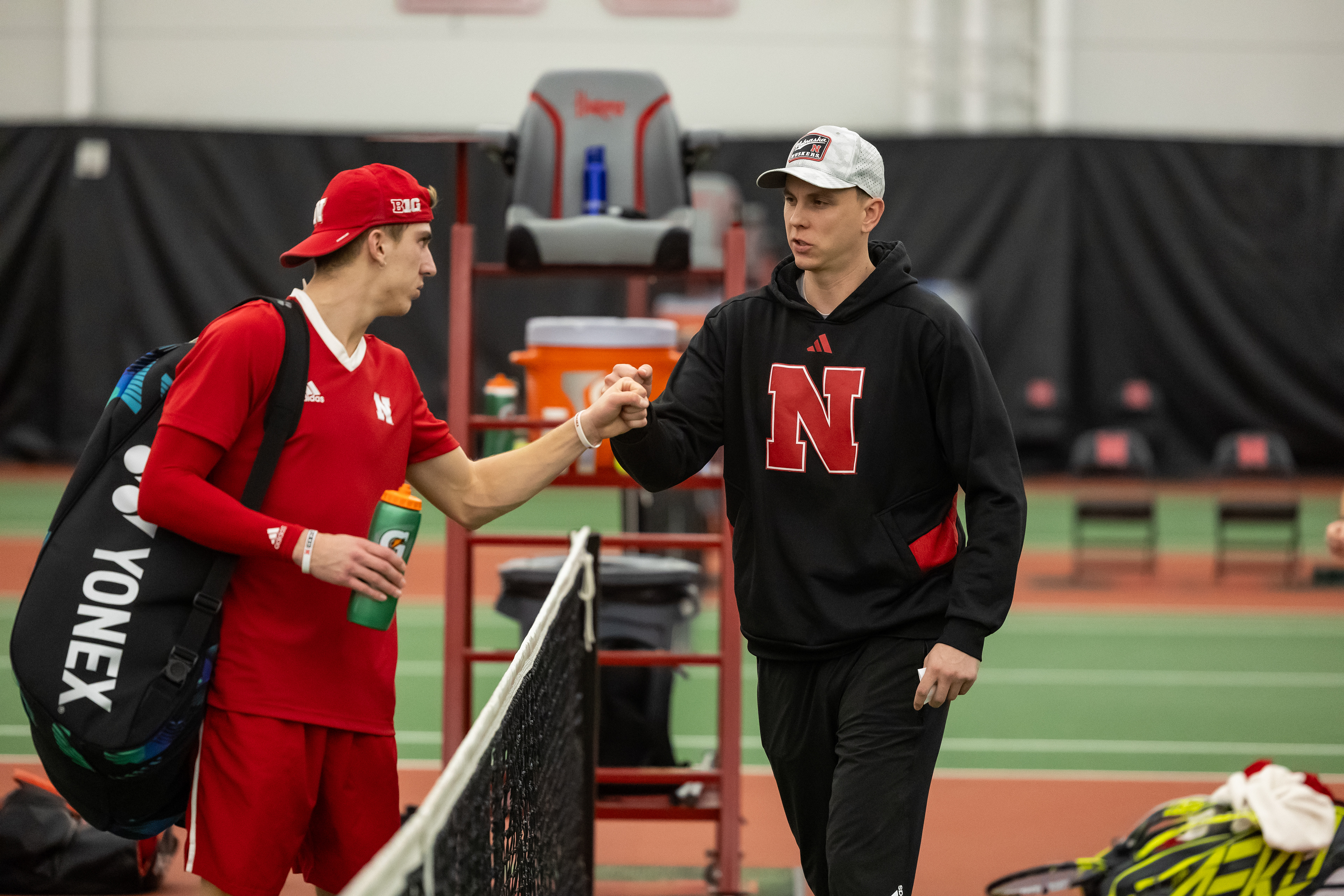
Photo Courtesy of Husker Athletics
Looking beyond borders: how international recruiting Is elevating Husker Athletics
When 21-year-old Virginia Adriano crossed an ocean from Italy’s top professional volleyball league to become a Nebraska Cornhusker, she arrived as part of a wave of athletes capitalizing on NCAA legislation allowing international professionals to compete collegiately.
The 6-foot-5 outside hitter, who played for Bergamo in Italy’s Serie 1A, has quickly become a star for the one of the nation’s top-ranked teams — proof that international athletes can thrive on one of college volleyball’s biggest stages. But while Adriano’s success, including making the conference All-Freshman Team, has turned heads across the country, other Husker sports have long been built on international talent, where recruiting across borders has become an essential part of remaining competitive at the NCAA level.
Nowhere is that more evident than in Nebraska men’s tennis, where seven of its nine athletes hail from outside the United States. For a program competing in a sport that draws much of its top talent internationally, recruiting abroad has become a strategy driven by both opportunity and necessity, as coaches search the globe for athletes who can elevate their teams in sports with smaller talent pools in the United States.
For Men’s Tennis Head Coach Peter Kobelt, the decision to prioritize international recruiting is rooted in the popularity of the sport worldwide.
“What's unique with tennis is that you have multiple countries where tennis is their second or third most popular sport in their country, so you tend to get a better athlete,” Kobelt said. “You tend to get someone that's been coached by a great coach.”
As of 2022, 61% of men and 66% of women NCAA tennis players are international. Many of these players come to the United States, often seeking a pathway that doesn’t exist at home, similarly to Adriano and Husker Volleyball.
“There are no college sports, obviously outside the US,” Kobelt noted. “When you’re 18 years old, if you’re not from the United States, you have to decide if you want to either go professional and continue playing or if you want to study. If they come here, they can do both.”
The process of finding and evaluating international athletes is a mix of deep research and relationship building. With the added accessibility of social media, Kobelt said that recruiting overseas has evolved much over the last decade. However, technology still doesn't replace the need for in-person visits.
“We take long road trips in the summer in Europe or wherever you go, country to country, recruit to recruit, trying to build relationships,” Kobelt said. “Because I believe, at the end of the day, it's still based simply on relationships and trust.”
According to Kobelt, since the best young international tennis players often decide between college and going professional immediately, the first step is convincing them that the college route is viable. Once they’re interested, it’s convincing them that a sea of red in the middle of the country at the University of Nebraska-Lincoln is the place for them. To Kobelt, the culture speaks for itself.
“I think it starts with the people here. They're hard-working, and they love and care about Nebraska,” he said. “Then you see we have the eighth most valuable athletic department in all of college sports. Our athletes have everything that you possibly need to be great. Knowing that men’s tennis is going to be around and Nebraska is going to be investing in tennis is a huge deal in today’s world.”
The global reach extends beyond the tennis courts. Nebraska's reliance on athletes developed outside the U.S. is a core part of its athletic identity, extending to several of its teams. Sports like swimming and diving as well as track and field have significant international representation, mirroring the necessity seen in men's tennis.
For men’s gymnastics, recruiting internationally isn’t just about filling roster spots, but about finding a competitive edge. At the college level, which is made up of only 15 teams, programs operate with limited scholarships and dwindling participation at the youth level in the United States.
“Recruiting from other countries allows us to expand our search to find the right pieces to succeed at the Big Ten and national levels,” said assistant coach John Robinson. “When you’re looking to maximize your roster, you should leave no stone unturned.”
Robinson said that recruiting international athletes helps bring in new knowledge and perspectives to help develop the team more efficiently as a whole. Several of Nebraska’s gymnasts return to compete for their home countries' national teams during the collegiate off-season.
“Our role is to fill in where there are gaps when it comes to supporting our student athletes when they represent and compete for their countries,” Robinson said. “When they win and their country wins, so do we. It’s a partnership that we’re proud to have.”
Kobelt testifies as well that the diversity his international recruits bring creates a special bond for the tennis team as a whole.
“They also get a chance to make friends with people who live all over the world,” he said. “They’ll have friends in a brotherhood with people from all the corners of the globe.”
From obtaining student visas to eligibility reviews, bringing an athlete from overseas to an NCAA program takes coordination across multiple departments. At Nebraska, the athletic department’s compliance office manages the complex, multi-layered process.
Jena Johnson, the Associate Director for Eligibility and Transfers, handles academic evaluations for international recruits, which she said can be made more complicated when verifying what is known as “amateur status” with the NCAA.
Coaches often recruit athletes who have delayed their college enrollment by a year or more to continue competing professionally, like Virginia Adriano. In order to be eligible to compete collegiately, the NCAA requires athletes to meet its definition of an “amateur athlete.”
“There’s tricky NCAA legislation in regard to if they continue to compete, which typically they do,” Johnson said. “They could be charged with seasons of competition, even if they weren’t enrolled.”
In its amateurism review, the NCAA evaluates various factors, like compensation for media appearances, prize money won in competitions, etc. The governing body also considers the compensation athletes receive beyond “actual and necessary expenses.” According to Johnson, in regard to international athletes, the NCAA tailors this evaluation to each athlete’s place of origin.
“What we've learned is that they take into consideration the standard of living for their area,” Johnson said. “Rather than just saying, ‘Oh, X number of dollars is a lot of money, or X number of dollars is not a lot of money,’ it's taking into account the standard of living in that specific region.”
For athletes who qualify for amateur status, receiving financial aid adds another layer of complexity depending on tax regulations and what country student-athletes are coming, according to Associate Director for Financial Aid Sarah Standley.
“Anything that would not pay tuition, fees or books has to be taxed,” Standley said. “We have to kind of keep that in mind when we’re discussing how much we’re going to potentially give them. Whatever amount we say we’re going to give them, they don’t actually end up receiving that amount because of the tax withholding.”
As expected, there are several other obstacles that can delay an athlete’s timeline to travel to the States and begin practicing, such as waiting on documents and obtaining the correct student visas.
“There are also rules about when they can come into the country, like they can’t come too early, but we also don’t want them to come too late and miss classes,” Standley said.
The process can even be further delayed by the risk of fraud, as Assistant Director for Recruiting Taylor Kissner added.
“We heard of an instance where a prospective student athlete was trying to get a visa, and he was scammed and got a fake one, and so then it threw off the entire process,” Kissner said. “Knowing who they can trust and what kind of competition visa you need just to come on a vacation here, if there’s prize money involved because they might be competing, that just makes it even more complicated.”
Once an athlete decides to sign with Nebraska and become a Husker, integrating them into Lincoln can be the next challenge, Kobelt said, especially when they may not have taken an official visit.
“You would think that recruiting athletes like this is all the same, but when you recruit international athletes, they all come from different countries with different mentalities,” Kobelt explained. “Coaching them can be a totally different thing. It’d be like, you know, coaching someone from Southern California and New York City. I try and ingrain them into the Nebraska community, and to what the university does as quickly as possible.”
Whether it’s a gymnast from Canada or a tennis player from Spain, Nebraska’s recruiting reach reflects the increasingly global nature of college athletics.
However, international athletes face a significant disadvantage in Name, Image and Likeness (NIL). Because most international athletes compete on “F-1” student visas, they are legally prohibited from “engaging in active employment” within the United States. In turn, they cannot receive compensation for endorsements, brand deals, or appearances, which is an emerging financial benefit for collegiate athletes in what is becoming a billion-dollar NIL industry. While some legislative efforts have been proposed to close loopholes and level the playing field for international athletes and NIL, the future is still unclear.
For Nebraska’s coaches, the goal isn’t just to find the best athletes in the world, but to find the right ones, wherever in the world they may be.